PLATTSBURGH, N.Y. — Brandon Palaniuk has made many memories on Lake Champlain, but most of them will have little practical application during the SPRO Bassmaster Elite at Lake Champlain.
Competition days will be August 13-16 with daily takeoffs from Plattsburgh City Marina at 7 a.m. ET and weigh-ins each day at the marina at 3 p.m.
Palaniuk won the 2020 Elite event at Champlain largely by targeting flats with scattered rock and boulders within the Inland Sea (Champlain’s northeast section). That’s not necessarily off the table for this year’s tournament, but Palaniuk said he’s seen the lake change in recent years and game plans that once produced are now far-less promising.
“I’ve noticed over the past few years, the smallmouth don’t set up like they used to; they seem to roam a lot more, they seem to scatter a lot more,” Palaniuk said. “When I won in 2020, those fish were more structure-oriented, but that doesn’t seem to be the case anymore.
“It’s not like you can just Spot-Lock and sit there and keep making the same cast on a place. When you catch one, they’re swimmin’ and they’re gonna keep swimmin’.”
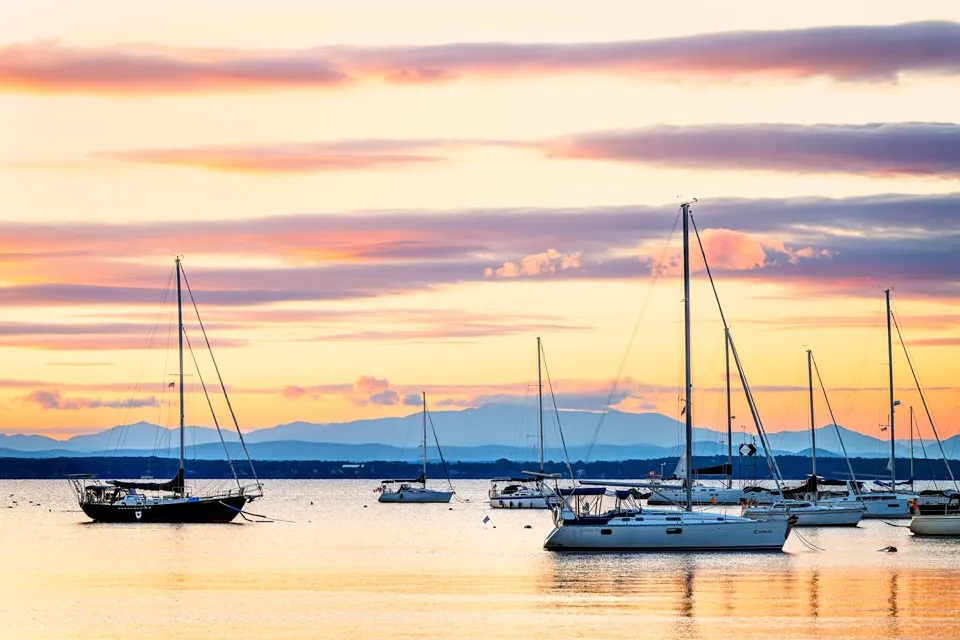
The simple solution traces back to the very reason Elite anglers delight in seeing Lake Champlain on the schedule. Earning its No. 5 ranking on the 2026 Bassmaster Top 100 Lakes Northeastern region list, this visually stunning lake is full of quality smallmouth and largemouth bass. This fishing pressure, especially forward facing sonar’s precision focus, has made the smallmouth more nomadic.
Noting an important distinction, Palaniuk said that Champlain’s largemouth have remained relatively consistent due to their preference for shallow cover such as docks, wood and vegetation. The main factors for largemouth positioning are variances in grass growth and weather systems like the heavy rain that inundated Upstate New York in late-July and early-August.
Straddling the border of New York and Vermont and reaching into lower Quebec, Canada, Lake Champlain stretches approximately 107 miles long and 14 across at its widest point. With its northern end comprising a mix of islands, bays and the Inland Sea, Champlain’s broad, deep center offers more open water, while the lower end narrows into more of a shallow riverine scenario past Crown Point.
As Palaniuk explains, summer tournaments typically find smallmouth bass dominating the numbers game, while competitive bags often include one or two kicker largemouth. That’s likely to hold true for the upcoming Elite tournament, but with this event prohibiting the use of forward facing sonar, strategies that have worked in the past are unlikely to deliver much consistency.
“I think this being a non-forward facing sonar event, that will change how guys approach it,” Palaniuk said. “That doesn’t mean you can’t catch those roaming smallmouth, but it definitely makes it a lot more difficult.
“I think you’ll have to fish near or around structure more, or you’re gonna have to throw more moving type baits and try to intercept those roaming fish. You’re gonna have to cover water; you’re not gonna be able to pan around out there and see them and throw a minnow on their head.”
Palaniuk expects to see anglers leveraging their lake mapping to identify likely smallmouth zones and then covering the area with jerkbaits, swimbaits, and topwaters. A few bites in one area might warrant a more focused effort with a dropshot, Ned rig or jighead minnow.
Largemouth anglers will use a mix of swim jigs, bladed jigs, topwater frogs, Texas rigs and flipping jigs. Champlain’s northern end holds a lot of the shallow habitat largemouth like, but Ticonderoga remains the lake’s wildcard.
Named for the historic fort on the New York side, this lower lake region’s shallow vegetation has long been Largemouth Central. The only drawback is that the 70-mile run from the tournament’s takeoff requires a serious time commitment. Moreover, if the day turns windy, the trip can turn treacherous and potentially threaten an on-time check-in.
Pointing out what he considers the key to success in this year’s Lake Champlain event, Palaniuk said: “Looking at it for what it is and not getting caught up in how we’ve fished it the last couple of years. It’s easy to get caught up in what you’re seen and where you’ve seen fish, but then not have the tools to be able to chase them.”
To that point, Palaniuk said he expects the lack forward facing sonar’s efficiency will keep the weights lower than normal. He expects anglers will need 19 1/2 pounds a day to make the top-10, with a 4-day winning weight of 84 pounds.
“I think the smallmouth will dominate the numbers, but I think you’ll see more largemouth play than in years past,” Palaniuk said. “They’ll be in places that are more predictable. They’ll most likely set up a little better and they’ll give you more consistency than the smallmouth.”
Live coverage of the 2026 SPRO Bassmaster Elite at Lake Champlain will be available starting August 13 and 14 at 8 a.m. ET on Bassmaster.com. FS1 will host the morning action on August 15 from 8 a.m. to 12:30 p.m. before heading to Bassmaster.com. Championship Sunday coverage can be found on FS1 from 8 a.m. to 1 p.m. and conclude on Bassmaster.com.
Weigh-ins will be streamed live on Bassmaster.com each day starting at 3 p.m. ET.
Discover Plattsburgh and the Adirondack Coast are hosting this event.